
Sample use case
Financial services
- Workloads
- Document extraction, analyst assistants, risk investigations
- Controls
- Structured output validation · private execution · complete audit trail
Accelerator · governed execution
A governed execution layer for enterprise AI and agent workloads. TerraFlow decides how an approved workload should run — context, cache, model and placement — and records why.
Token growth is only one visible symptom. Every workload now crosses models, data, tools, policy and infrastructure.
Long contexts, agent loops, retries and duplicated prompts make cost per accepted outcome hard to control.
One model cannot serve extraction, reasoning, code and tool use with the same quality and latency profile.
Sensitive data, regional requirements and internal access rules determine where a request is allowed to run.
Different gateways, providers, models, tool servers and GPU clusters create failure and audit gaps.
| Layer | What it does well | Where it stops |
|---|---|---|
| LLM gateway | Provider access, retries, basic routing | Does not understand workload outcome or private capacity. |
| Model router | Selects a model from a candidate set | Usually lacks context policy, tool control and route evidence. |
| Cache layer | Avoids repeated inference | Requires strict freshness, tenant and provenance controls. |
| Inference server | Optimises GPU serving and KV reuse | Operates below business policy and cross-provider decisions. |
LLM gateway
What it does well
Provider access, retries, basic routing
Where it stops
Does not understand workload outcome or private capacity.
Model router
What it does well
Selects a model from a candidate set
Where it stops
Usually lacks context policy, tool control and route evidence.
Cache layer
What it does well
Avoids repeated inference
Where it stops
Requires strict freshness, tenant and provenance controls.
Inference server
What it does well
Optimises GPU serving and KV reuse
Where it stops
Operates below business policy and cross-provider decisions.
TerraFlow connects these layers through one workload contract, one policy decision and one auditable execution record.
quality, cost, latency, data
context, cache, model, route
identity, residency, tools, approval
outcome, audit, evaluation, learning
A router is one decision inside TerraFlow. TerraFlow owns the whole execution plan.
A policy-based router chooses an approved execution path for each request, within its data boundaries and token budget.
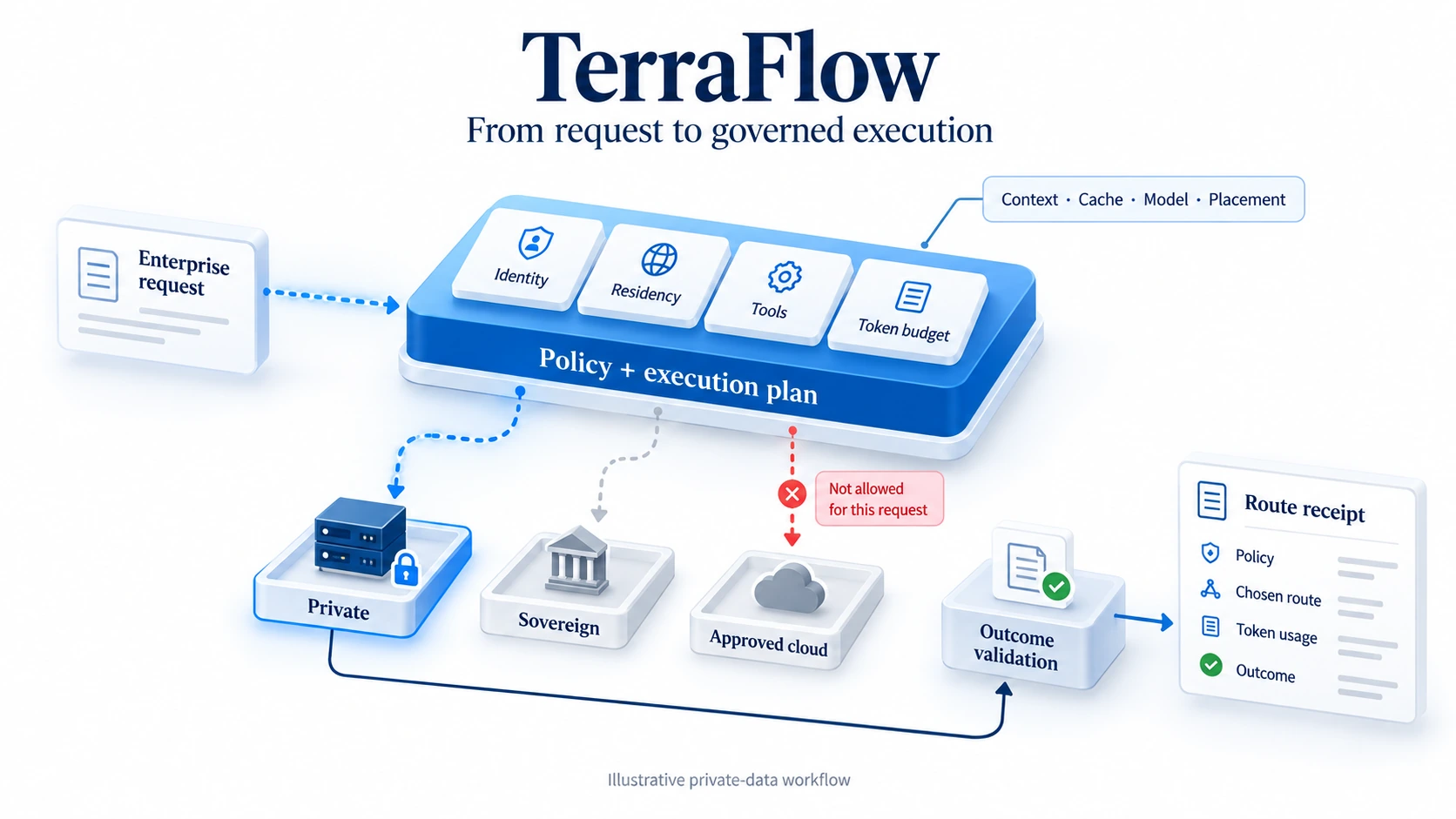
Illustrative private-data workflow. The blue route runs privately; the red gate blocks external execution for this request.
Open full diagram (opens in a new tab)01
Identity, data residency, permitted tools and token budgets define the boundary before a request runs.
02
Context, cache, model and placement are planned within that boundary. This sensitive request stays private; external execution is blocked.
03
The result is checked and a receipt records the policy, chosen route, token usage and outcome. Any fallback must also satisfy policy.
Every request starts in an application or an agent.
TerraFlow reads its workload contract: quality, cost, latency and data class.
Policy decides where it may run — identity, residency, tools, approval.
The optimiser chooses context, cache, model and route within the limits policy set.
This request runs on a private model inside your environment, because policy allows nothing else for its data.
Every execution leaves an auditable route receipt.
Outcomes feed back into the next plan.
The same lifecycle applies to a single model call, a document workflow, or each step in a long-running agent task.
identity, data class, task, service level
allowed models, regions, tools, budget
context, cache, route, capacity
model, tool, agent or private cluster
quality check, policy check, confidence
receipt, telemetry, evaluation feedback
If validation fails or conditions change, TerraFlow repairs the plan and escalates only when policy allows.
Bring in only the memory, retrieval results and tool outputs the task needs.
Preserve stable prefixes and use provider or private prefix caches.
Use exact and semantic caching only where freshness, access and provenance allow it.
Choose private, sovereign or cloud execution based on data and capacity constraints.
Match the task to an approved model, tool, specialist or escalation path.
Expose cache affinity, batching and self-hosted serving controls when you own the stack.
Classify inputs, enforce permitted regions and execution boundaries, and protect tenant separation.
Carry user and workload identity to approved tools, with least privilege and policy-scoped capabilities.
Record the policy, route, inputs selected, cache status, retries and outcome for each execution.
Handle outages, rate limits or low confidence through guarded fallback, escalation and review.
Sample use case
Sample use case
Sample use case
Sample use case

Used in
In an engagement
Policy decides where each workload may run, and every execution leaves an auditable route receipt, so the pilot is governed from its first request.
AI models, apps and agents, and the integration and cloud work around them.
Explore full-stack AIFrom scattered data to AI agents that do real work, on your platform.
Explore data to agentic AIStart with control and visibility, then add optimisation only where it is proven to preserve the required outcome.
TerraFlow gives you a durable control layer as models, tools, regulations and deployment options keep changing.